Showing posts with label Robert L. Folkner. Show all posts

Wednesday, October 29, 2014

Something more on Halloween...this time not so silly

Again, something on Halloween, and something about the book by Robert Folkner, Pure Theatre of Cruelty...(the link to which is below).

But this time, not so silly, not so funny...


Link to Pure Theatre of Cruelty: http://www.amazon.com/Pure-Theatre-of-Cruelty-ebook/dp/B00CTCDCSO

Tuesday, October 28, 2014

Something silly for Halloween...plus a good book.

Like it says, something very silly for Halloween. Plus a link a very good, very spooky book, Robert Folkner's Pure Theater of Cruelty, which will be free from Tuesday, Oct 28, through Saturday, Nov 1, 2014.

The hotlink's below the video.


DA LINK

Robert Folkner's Pure Theatre of Cruelty
http://www.amazon.com/Pure-Theatre-of-Cruelty-ebook/dp/B00CTCDCSO

Tuesday, September 23, 2014

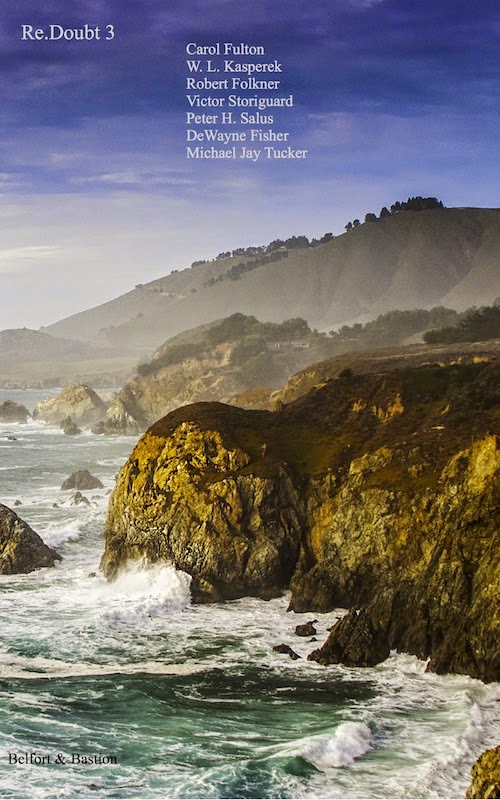
Re.Doubt3! And it's FREE for five days!!!

Okay, Re.Doubt3 has just gone live!

What's that you say? Well, we answer, Re.Doubt is Belfort & Bastion's little literary magazine. And we've just done issue number three.

This time around we've got poetry from Carol Fulton and W.L. Kaserpek, fiction from Robert Folkner and Victor Storiguard, non-fiction from Peter H. Salus, and terrific nature photography by DeWayne Fisher.

AND best of all, it will be free to download from Amazon from 24 Sep to 28 Sep, 2014!

So check it out while it's on special! Just click on the link below:

http://www.amazon.com/dp/B00NOATZ40http://www.amazon.com/dp/B00NOATZ40


http://www.amazon.com/dp/B00NOATZ40 


Tuesday, July 15, 2014

Our freebie e-book blowout continues

We're stilling giving away tons of free e-books!

On Wednesday,  July 16, and for one day only, Jerry McMurry's fascinating collection of prose sketches, Ice Cream Counter, will be FREE for the download from Amazon. It is a fun, insightful, and humane work that everyone will enjoy. Do be sure to download it.

It is here: http://www.amazon.com/dp/B00JSCR6NA

Also, on going until July 18, Robert Folkner's reworking of the Faust tale, Something For Everything, is FREE on Amazon. So give this one a look. It is a highly inventive and disturbing exploration of human nature.

It is here: http://www.amazon.com/Something-For-Everything-ebook/dp/B00BC0JKEO

Plus, don't forget, W.L. Kasperek's debut collection of poetry, Lucky Pennies, will be FREE from July 18 until July 22. Well worth the read.

It is here: http://www.amazon.com/dp/B00E7HNCYI

And, finally, if you are a day trader, you'll want this one. Richard Arms book on his new technique of charting, Arms Candlevolume, will be FREE on July 19 and July 20. This one could be important to the Wall Street pro.

It is here: http://www.amazon.com/dp/B00KFX2JTM


Friday, July 11, 2014

Free on Amazon this week: Something For Everything

So what Belfort & Bastion e-book will be free this coming week? We've got a scary one for ya.

On July 14 and running through July 18, 2014, (that's Pacific time) Robert L. Folkner's Something For Everything will be available for free. This is a fascinating (if somewhat terrifying) retelling of the Faust tale from the perspective of an American teenager in our grim, post-industrial world.

Be sure to download! Just go to:

       http://www.amazon.com/Something-For-Everything-ebook/dp/B00BC0JKEO

And ask yourself, what would you give up to have everything you always wanted?


Wednesday, June 12, 2013

I Frighten

Today, we need talk about a book, a writer, and a Latin word.

And, believe it or not, there's connection. And something very, very important for us all.

The writer first. Robert L. Folkner is one of Belfort and Bastion's favorite authors. He's already done one novel for us, Something For Everything. It is a sort of a retelling of the Faust tale but from the perspective of a modern American age of post-industrial decline.

But, now, Folkner's done a second work for us. This is a collection of short stories entitled Pure Theatre of Cruelty.

Now, for the word: terreō

It means, more or less, "I frighten."

Which is where we get into the important part.


*

Terreo is one of those interesting Latin words which shows up as multiple words in English. Most obviously, of course, is "terror." Related to that is "terrible." So there's two words and two distinct concepts right there. We have terreo in the sense of cause of causing fear—i.e., "The 9/11 hijackers were terrorists." But we also have the sense of something very, very bad, either in the meaning of evil ("The Cambodian Genocide was terrible,"), or in the meaning of something awful ("That dinner was terrible.")

But, curiously, terreo also shows up in English to mean something good, as in "Terrific."  Thus we have, "She's a terrific human being."

The problem arises because the underlying meaning of "terreo" got a little slippery when it was transferred to English via Norman French. When it got grafted onto what used to be Anglo-Saxon, it took on the meaning of something which evokes the grander emotions, whether for good or bad.

That's why translating "terror" or "terrific" can get tricky. Take Czar Ivan IV. We call him, in English "Ivan The Terrible" because he was known among the Russians as "Ivan Grozny."  So we have a vision of Ivan as a tyrant, "the Terrible," a kind of precursor of Stalin.

Except that Grozny doesn't really mean "terrible" in the sense that we know it today. In Russian it is more like "strong" or "formidable,"—more, in fact, like our "terrific." What happened was that when the title was translated into English in the 1500s, the translators were looking for a word that meant something "awe-inspiring," and (at the time) "terrible" did just that. " It was only after a few hundred years that the English-term had taken on today's more negative meaning.

Which isn't to say that Ivan the Terrible wasn't, indeed, "terrible" as we use the term today. He probably was. But, as one of the founders of the Russian state, and the man who helped put down the foundations for the Russian empire in Siberia and Central Asia, he might have a rather good claim on "Terrific" as well.

But, what's that got to do with Robert Folkner? For that, we need to turn to Theatre.


*

Folkner is a fabulist. Or, as he prefers to call himself, "a Fantasist." His fiction weaves in and out of the real world, taking the reader from the mundane to the fantastic, and back again …all in a matter of a few pages.

His current book with us, Pure Theatre of Cruelty, includes a number of tales…all of them fundamentally disturbing. There is "Classical Massacre," which gives us a pretty "terrible" picture of what a nuclear weapons strike would be like. Then, too, there's  " Fortune-Baby," where the supernatural, the cinema, and perfect justice all somehow become intertwined. And there's "Everyone Gets What He Deserves," which asks what would happen if our juvenile justice (or injustice) system were to gain a little too much power. And, well, there's much more beyond those.

The connection with terreo? Simply this: Folkner's tales are of the same stuff as terreo. They evoke terror, but also are terrific.

They evoke terror because they deal with horrible, horrible things—the death of children, torture, the heartbreak of exile. But they are terrific, not just because they are well written (they are) but because they are warnings. They are signposts that read "here there be dragons," and suggesting alternative routes.

Take "Classical Massacre." At first glace, the reader would be tempted to dismiss it. After all, the Cold War is over. The threat of nuclear annihilation is over, isn't it? This is passé, isn't it?

Or is it? As I write this, in 2013, at least five nations possess nuclear weapons—including North Korea and Pakistan, neither of which looks like a monument to national stability. Several other states have the capacity to produce them any time they like. And there are almost certainly non-state actors— Al-Qaeda, for one—trying to get them.

Oh, and here's something else to consider. What's one of the most rapidly accelerating arms races in the world right now? Try India and China, both nuclear powers with missile programs. Just last year (2012) India debuted the Agni-V, a ICBM that can carry multiple nuclear weapons. It's called "the China killer."

Consider that for a moment.

*

Or take "Everyone Gets." I won't provide any spoilers but suffice to say it involved a future in which the juvenile justice system meets time travel. A simple sci-fi/horror tale, you say?

Well, maybe yes, maybe no. Consider the social trend knownas  "the criminalization of children." It's been written about everyone from scholarly journals to the New York Times. Increasingly, we treat young people as criminal, guilty until proven innocent.

Thus schools are built like armed camps. Police are now regularly stationed in every school in the country…not to protect the young people from machine gun welding maniacs, but to keep the students in line.

How long before society's "terror" of the young becomes truly deadly?

*

So this is why Folkner is "terrible" and "terrific." He warns us. He points at the dark places in our society…and in our souls…and says "Here there be demons."

Here, he says, are things you must avoid. At all costs, you must avoid them. If you do not, then…well…the world is threatened.

And so Folkner joins that tiny band of writers, the men and women who stand before us with magic mirrors. They present us with our own secret faces…faces that may, indeed, be terrible.

Such people, such artists, are important …as important as those who follow Caesar and whisper, "you are mortal."

These men and women follow us all. And say, "Terrific or terrible…you can be either.

"The choice is entirely…entirely!… up to you."

Let us hope to God we make the right choice.


*

You may see Pure Theatre of Cruelty at Amazon here:

http://www.amazon.com/Pure-Theatre-of-Cruelty-ebook/dp/B00CTCDCSO


Monday, April 1, 2013

Something For Everything by Robert L. Folkner


1.

This month, Belfort and Bastion is proud to announce a new book and a new writer. The former is Something For Everything and the latter is Robert L. Folkner.

So what's the novel about? Ah, that's complicated. In some ways, it's Faust. In others, though…

Well, let's just say that this is a subtle bit of social criticism. And very, very potent.


2.

When Folkner first approached us with the book, 'twas I who got the job of shepherding the manuscript through development. As I understood the pitch, it was a of reworking of the Faust story, but with the main characters being teenagers—sort of Goethe for the Young Adult Fiction market. And that's a good thing. Every publisher worth its salt is busy looking for the next R.L. Stine.

But then I got the manuscript. And, guess what…I had completely misjudged the work and its creator. Oh, Faust was there, no doubt. Something for Everything tells us the story of two young men, Bradley Hollenger and Ricky Stromberg, living in a rust belt city and dreaming of better things, even as they are all too clearly fated for lives of dreary struggle. Then, one of them meets a mysterious pair of twins…as we learn, supernatural beings.

The obligatory deal is struck. And the fortunate young man finds his life transformed. All that was denied him is now available.

Ah, but the price, we learn, is steep.

As I say, when I first saw the proposal, I thought that's all there was to the book—an interesting, serviceable (if not particularly original) plot and well-done characters. And, both are present. Both are nicely crafted. The writing's clear and clean. The two boys are well delineated and artistically drawn.

Except, when I began reading the thing in detail, I realized that while these things are indeed present, there's a great deal more going on between these pages. Mr. Folkner isn't just telling us a story. He is presenting us with …

America.


3.

First, background. Folkner is one of that vanishing breed, an American industrial worker. He lives in one of the grimy, factory towns he describes. He earns his daily bread by operating a complicated machine that shapes metal. He lives with the very real threat that someday his livelihood will vanish. Such is the fate of the American Man (and Woman) in our postindustrial age.

Yet he is also an educated man…largely self-educated, but thoroughly so. He has spent decades reading history and literature, art and science. He observes his world, and our world, with a trained eye.  (He reminds me a little of that other great autodidactic, Eric Hoffer, who worked the docks during the day, and produced brilliant philosophic treatises at night. Naturally, the Learned and the Wise have never forgiven Hoffer. I wonder if Folkner will be as little loved by the Academy.)

And I should have thus seen what he was up to just from my knowledge of his biography. But, I really didn't get it …didn't understand how completely I'd misjudged Something For Everything …until I heard a quote about the book. Among of its early readers was one of Mr. Folkner's co-workers. The friend loved the book because, he said, he "identified with the Bradley Hollenger character [since he] himself grew up in a crumbling, decaying part of Minneapolis."

And that's when it hit me. Where are these people living? I mean, Folkner's characters? These two boys and their families? Not Hollywood or Beverly Hills. Not southern Manhattan or the Gold Coast. Not the centers of American wealth and power where, logically, a writer would put a Faust story (or, at least, have his characters drift towards).

No. They are in a dirty, grim, rust-belt city…where layoffs and pink slips are the norm, bitterness a given, and despair a way of life.

They are, in short, confined in that greater prison of our collective soul—postindustrial America. They are our analogs and designates, or metaphors and surrogates, our body-doubles…the boys (and girls) we were once or are now, taught to believe that the world was ours for the taking if we only worked hard enough and followed the rules, only to find that the world has (somehow) been snatched away from us at the very last minute.


4.

Thus, you can find Bradley Hollenger and Ricky Stromberg on the streets of any American city or town…and, increasingly, on any campus. The middle class withers, jobs flow overseas or to machines, the young discover they are unemployable, and the aged become desperate.

And what takes the place of hope in such a world? When so little is genuinely offered to us? Consumer goods, of course. Or rather, the wish to have them. Day and day out, we are presented with a barrage of images…on TV or in movies (product placements) or on the web…of Things We Are Told We Really Want (but actually can't afford). Cars and watches, jewelry and clothes, electronic and other toys, these crowd in upon our consciousness and corrupt our very souls.

And in this postindustrial age of poverty and want, who are our heroes? Who are the people we are told to admire? They are no longer the creative or the forceful. Rather, they are champions of consumption. They teach us not self-discipline or wisdom, but rather what and how to buy, regardless of the cost. Somehow, by some mysterious and terrible process, the Kardashians have become our gods, the Beverly Hills Housewives are the captains of our souls…

And who are Mr. Folkner's deadly twins? The Two who come to tempt the boys? Is it not obvious? Is it not plain? They are those men and women who stand glittering and lovely on the brand new flat screen 3D display, offering us all that we desire (so long as they get to define what it is we want).

Ah, but there's the rub. If we should, somehow, obtain those goods and toys, we find they are unfulfilling. We find that they do not ease that horrible ache within us. Indeed, we find that possessions leave us desiring more than ever, like the junkie who cannot quite get enough of his injection, or the compulsive eater who can never get her fill. We feel the emptiness within us, so we buy to fill it, but those purchases leave us more hungry than before, and so we must buy more.

And so on, unto the grave.


5.

And so we come to the deeper meaning of Mr. Folkner's book. He comes to us not just as a novelist but also a fabulist and an educator. What he is telling his readers, and particularly the younger ones, is that postindustrial consumer society is a trap. It offers everything…all the marvels of the material world…but it delivers nothing.

Indeed, possession becomes a kind of, well, possession. We buy possessions for the sake of buying, and somehow we become possessed. We are possessed by the demons of consumption. Purchasing  becomes a religious duty. The career becomes all important. The paycheck (a large one) is more vital than the self. Family, friends, artistic and personal expression, quiet contemplation, all wither before the demands of the credit card.

This is Folkner's warning. Pay heed, he says, to what really matters. And what really matters may not be what you are told you desire.

It may be, in fact, the exact opposite of what you hear on TV, of what you read about celebrities, and what appears (sparkling and golden) when you click links on Web pages.

Thus Mr. Folkner's message to the young, and, yes, to us all.

Still, there's one other point I need to raise about him. If the above was all he achieved, then Folkner would have done the reading public a service. But he goes beyond that. He is no mere Cassandra. He does not simply point out the problems of the world.

He offers a solution. To wit, he offers Voltaire.


6.

Probably the most famous words that Voltaire ever put to paper come near the end of his Candide. You know, of course, the tale. After long years of disappointment, the young Candide realizes that only by tending to one's affairs may we achieve something like utopia: Il faut cultiver notre jardin.

What Folkner says is like that. Only, he tells us, by resolutely avoiding the temptations of excessive consumption, or grandiosity and megalomania, can we find something like happiness.

To live, we must turn our backs upon the Twins and the more obsessive aspects of consumer society. We must learn to see their offerings (their bait) as being the shining but empty dangers they really are. We must learn not to fall for their scam. Their deadly, addictive, hollow gifts.

We must, in other words, cultivate our own garden.

And there, of course, is where Folkner is at his most important. His message is vital. He tells us the postindustrial age is not pleasant. We have been badly cheated. We labored long decades… generations!...to make America great. We invested our talent, our sweat, and yes, our blood.

But, somehow, somewhere along the way, a tiny elite took away the value that we'd worked so long to create. Wealth was shifted wholesale from the middle class to the rich. Jobs were "out sourced" and "off shored." Our present was made grotesque and our children's futures were stolen. And then, to add insult to injury, those who have taken the most from us have announced that it was, after all, our own fault; that if only we weren't lazy and stupid, like "the 47%," then we wouldn't be in this mess.

Folkner, however, tells us…No. He says Pay No Attention To Them. He says work, yes, but work for your own well-being and that of your family, your friends, and your community. Work, but expect only small changes, little changes, and…given enough time, maybe generations…eventually that grim, post-industrial city will become once more shining and wonderful.

And the Great? The Powerful? The Twins? Those who stole our heritage and now consider us parasites and fools?

Well, one day, they may look up…look away from their toys, their Lear Jets and Penthouses…and realize (OhMyGod!) that they are utterly irrelevant. Utterly without purpose. Utterly unimportant.

And forever exiled from the Garden.


~The Editors


Something For Everything is now on Amazon here.